
Sorry, but your login has failed. Please recheck your login information and resubmit. If your subscription has expired, renew here.
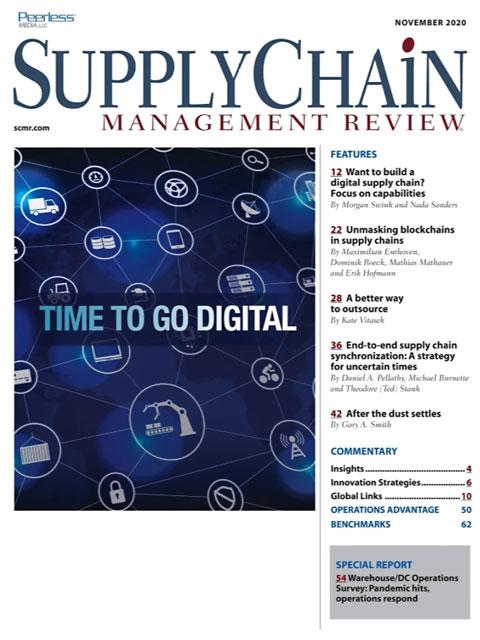
November 2020
Supply chains have been in the spotlight like never before over the last eight months. That hasn’t always been a good thing. The perception, reinforced by shortages of products essential to our daily lives, is that supply chains were not up to the task and failed. The reality, as argued by MIT’s Yossi Sheffi in his new book, “The New (Ab)Normal: Reshaping Business and Supply Chain Strategy Beyond COVID-19,” is that supply chains performed as designed—they did what we expected them to do. Browse this issue archive.Need Help? Contact customer service 1-508-503-1313 More options
The world is undergoing a fundamental change that began before the pandemic and will continue in a post COVID-19 world. In my view, it boils down to one thing: People are treating each other as human beings and being more kind to one another. That may seem out of step with the state of our political discourse, especially in an election year, but if you look around, it is happening and it is a growing trend.
To get us through COVID, CEOs and their boards temporarily put their salaries on hold in solidarity with their workers. Companies extended benefits to furloughed employees. And, let’s not overlook that the U.S. government passed a $2 trillion stimulus package that was unprecedented in its reach and scope. While the outcome is uncertain, at the time of this writing, negotiations continued on another stimulus package. In a recent New York Times column, Tom Freidman noted this phenomenon, quoting his friend Dov Seidman who said: “In my view, trust is the only legal performance enhancing drug. Whenever there is more trust in a company, country or community, good things happen.”
Could we be experiencing a paradigm shift from a “profit first” to a “people first” culture?
That may seem like a loaded question, especially at a time when the word socialism is bandied about as a weapon. However, putting people first does not signal the end of capitalism; rather, it is capitalism for the long term.

This complete article is available to subscribers only.
Log in now for full access or start your PLUS+ subscription for instant access.
SC
MR
Sorry, but your login has failed. Please recheck your login information and resubmit. If your subscription has expired, renew here.
November 2020
Supply chains have been in the spotlight like never before over the last eight months. That hasn’t always been a good thing. The perception, reinforced by shortages of products essential to our daily lives, is that… Browse this issue archive. Access your online digital edition. Download a PDF file of the November 2020 issue.The world is undergoing a fundamental change that began before the pandemic and will continue in a post COVID-19 world. In my view, it boils down to one thing: People are treating each other as human beings and being more kind to one another. That may seem out of step with the state of our political discourse, especially in an election year, but if you look around, it is happening and it is a growing trend.
To get us through COVID, CEOs and their boards temporarily put their salaries on hold in solidarity with their workers. Companies extended benefits to furloughed employees. And, let’s not overlook that the U.S. government passed a $2 trillion stimulus package that was unprecedented in its reach and scope. While the outcome is uncertain, at the time of this writing, negotiations continued on another stimulus package. In a recent New York Times column, Tom Freidman noted this phenomenon, quoting his friend Dov Seidman who said: “In my view, trust is the only legal performance enhancing drug. Whenever there is more trust in a company, country or community, good things happen.”
Could we be experiencing a paradigm shift from a “profit first” to a “people first” culture?
That may seem like a loaded question, especially at a time when the word socialism is bandied about as a weapon. However, putting people first does not signal the end of capitalism; rather, it is capitalism for the long term.
SC
MR


Latest Supply Chain News
- NextGen Supply Chain Conference unveils agenda focused on AI, execution and the future of leadership
- From fragmented negotiations to coordinated negotiation performance: an AI-enabled approach
- Supply chain resilience isn’t a data problem; it’s a judgment problem
- Beyond the hype: Building flexible and scalable supply chains in a VUCA world
- Why your supply chain risk management plan will fail
- More News
Latest Resources
 Explore
Procurement & Sourcing News
- Why companies blame the wrong supplier … and miss the real failure
- NextGen Supply Chain Conference unveils agenda focused on AI, execution and the future of leadership
- From fragmented negotiations to coordinated negotiation performance: an AI-enabled approach
- Supply chain resilience isn’t a data problem; it’s a judgment problem
- Why your supply chain risk management plan will fail
- When component verification becomes operational
- More Procurement & Sourcing
Latest Procurement & Sourcing Resources
Subscribe

Supply Chain Management Review delivers the best industry content.

Editors’ Picks



